
Peptides for Skin: Benefits, Types & How to Use Them
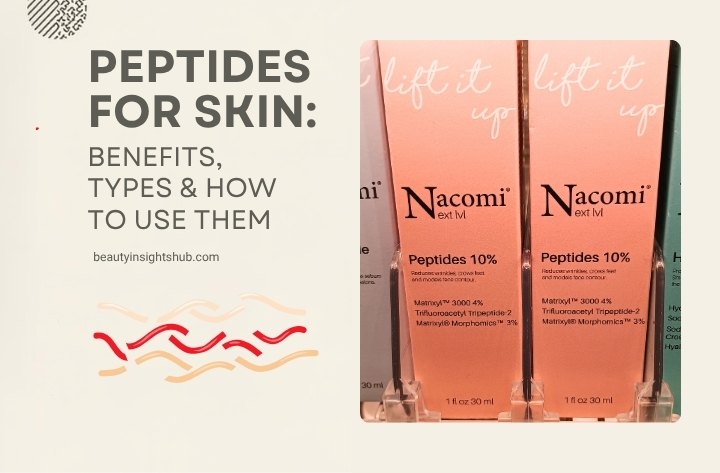
If you’ve opened a skincare website recently, you’ve probably seen the word “peptides” thrown around like it’s the secret to eternal youth. Serums, moisturisers, eye creams – everything seems to be peptide-powered these days. But what actually are peptides, and are they really doing anything for your skin, or is it just clever marketing?
In this guide, I’ll break down what peptides can (and can’t) do, the types you’ll see on ingredient lists, and how to use them in a simple, realistic routine. No fluff, no overcomplicated science – just the basics you actually need to know.
Table of Contents
What Are Peptides in Skincare, Exactly?
Peptides are tiny molecules that your skin already recognises. They’re made from amino acids, which are basically the small “building blocks” your body uses to make bigger structures.
When several amino acids join together, they form a peptide.
When lots and lots of amino acids join together, they form a protein.
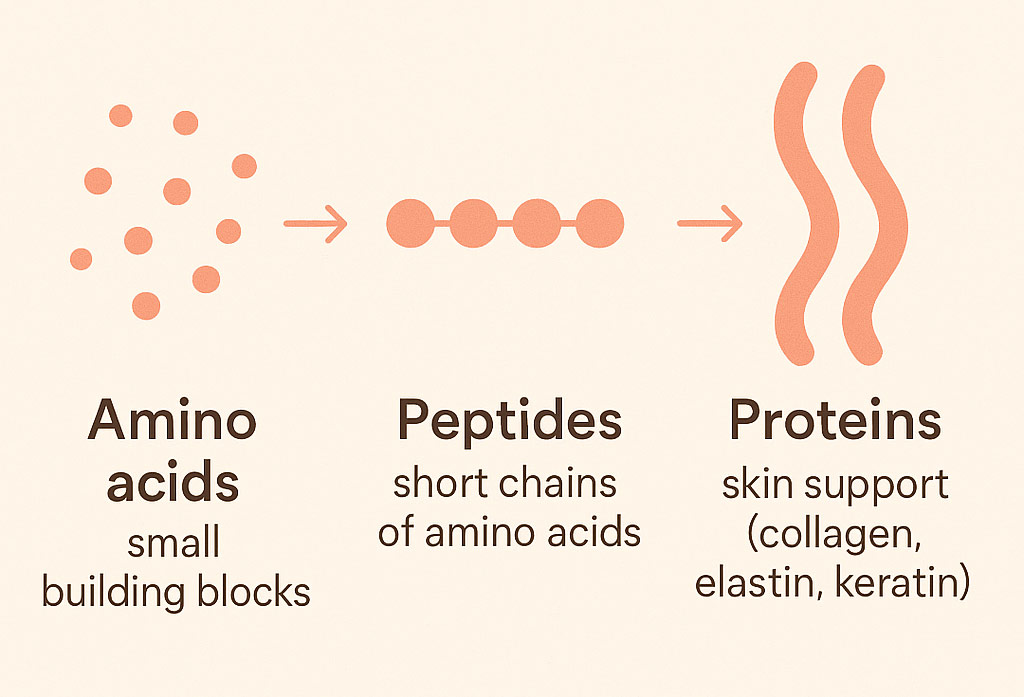
So peptides aren’t proteins – they’re the smaller pieces that proteins are made from.
Why does that matter for your skin?
Because your skin relies on a few key proteins:
- Collagen – gives your skin firmness and structure
- Elastin – helps skin stretch and bounce back
- Keratin – keeps the surface strong and protected
As you age, your skin naturally makes less of these. That’s when you start noticing changes like fine lines, less elasticity and a bit more dryness.
Peptides in skincare help because your skin can recognise certain peptide patterns as signals for repair and renewal. When it picks up those signals, it may respond by supporting collagen, keeping elasticity in check and strengthening its barrier. Over time, this can contribute to skin that feels firmer, smoother and better hydrated.
What Do Peptides Actually Do for Your Skin?
Peptides don’t all work the same way, but most of them support the skin in a few key areas. Here are the main benefits, based on current research, explained simply.
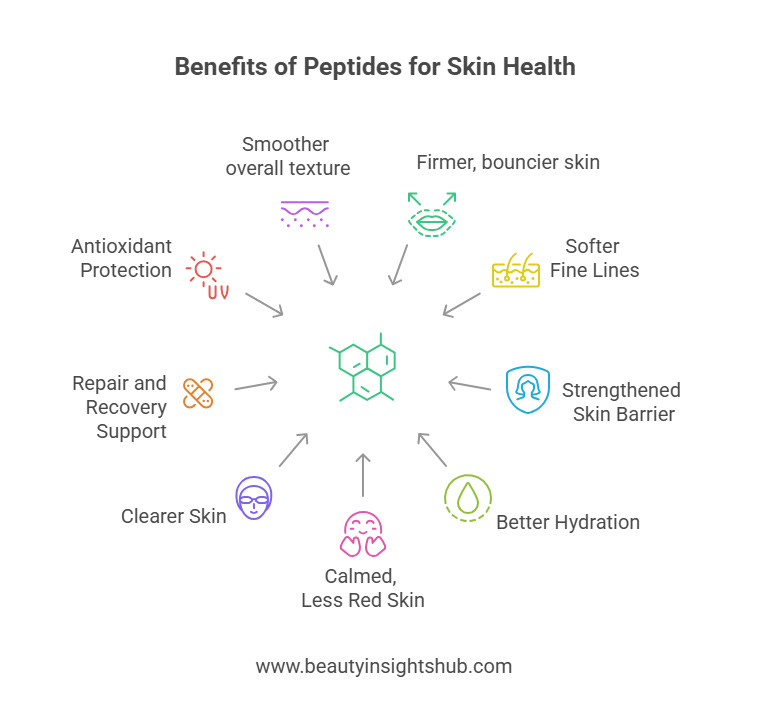
1. Improve firmness and elasticity
Some peptides (known as signal peptides) can help the skin maintain collagen and elastin – the proteins that keep your face firm and bouncy. This can lead to skin that feels a bit tighter and more lifted over time.
Example: palmitoyl tripeptide-5.
2. Soften fine lines and wrinkles
By supporting collagen and helping the skin stay better hydrated, some peptides can reduce the appearance of fine lines and early wrinkles and give the surface a smoother look over time.
Example: palmitoyl pentapeptide-4 (Matrixyl), which has shown anti-wrinkle effects in clinical studies.
3. Support a healthier skin barrier
Your skin barrier is what keeps moisture in and irritants out. Some peptides strengthen this barrier and help it repair itself, which is especially useful if your skin gets easily dry or reactive.
Example: rice peptides, soybean peptides (both plant-derived).
4. Boost hydration
Some peptides help the skin stay better hydrated by reducing how much water escapes from the surface. This is known as TEWL, or transepidermal water loss – basically, the amount of water your skin loses during the day. When less water escapes, your skin feels more comfortable, looks plumper, and stays moisturised for longer.
Example: palmitoyl tetrapeptide-7.
5. Calm redness and sensitivity
Some peptides have anti-inflammatory properties and can help soothe irritation from sun exposure, retinoids or over-exfoliating. Great if your skin is easily unsettled.
Example: acetyl tetrapeptide-15.
6. Support clearer-looking skin and help with occasional breakouts
Some peptides have gentle antimicrobial or balancing effects. They can help calm stressed skin and keep things looking more even – helpful if you deal with the occasional breakout or irritation.
(They won’t treat acne, but they can complement a balanced routine.)
Example: soybean peptides with antimicrobial activity
7. Help with repair and recovery
Certain peptides support the skin’s natural repair process. Copper peptides are well-known for this – they can help the skin bounce back after irritation and support healthy tissue renewal.
Example: copper tripeptide-1 (GHK-Cu).
8. Provide antioxidant protection
Many peptides also act as gentle antioxidants. They help neutralise free radicals – the unstable molecules created by UV exposure, pollution or inflammation that contribute to visible ageing.
Example: peptides containing histidine or phenylalanine.
9. Improve overall texture and smoothness
By supporting collagen and helping the skin stay hydrated, some peptides can make rough or uneven skin feel smoother. This applies to both dry patches and oily, uneven areas.
Example: hexapeptide-12.
In short…
Peptides can help skin look firmer, smoother, calmer and more hydrated – and they do it gently. The benefits you see depend on the type of peptide used, so not every peptide will do every job.
Real results also depend on how well the product is formulated – not every cream with “peptides” on the label is equally effective.
The Main Types of Peptides in Skincare (And How to Read the Names)
Now that we’ve covered what peptides are and what they can do for your skin, the next step is making sense of all those names on ingredient lists.
Behind the scenes, cosmetic chemists usually sort peptides into a few official groups based on the “job” they do in your skin:
- Signal peptides – support your skin’s own repair and renewal
- Carrier peptides – help deliver minerals needed for repair
- Neurotransmitter-inhibiting peptides – gently target movement lines
- Enzyme-inhibiting peptides – help protect collagen from being broken down
You don’t need to remember all of this. Think of this section as a simple cheat sheet so you can look at a label, recognise the type of peptide you’re seeing, and know roughly what it’s there for.
Signal peptides – the “keep things running” group
Signal peptides are the “manager” peptides. They don’t do the physical work themselves, but they remind your skin to keep up its normal maintenance jobs – like making collagen, elastin and other support molecules.
According to research, certain signal peptides (like palmitoyl pentapeptide-4 and palmitoyl tripeptide-5) can encourage the cells in the deeper layer of the skin that build your support structure to stay more active. In simple terms, they help your skin keep making the stuff that keeps it firm and bouncy, which is why they show up so often in anti-ageing products.
You’ll usually find signal peptides in serums and moisturisers that talk about firmness, elasticity, “anti-wrinkle” or “collagen support” on the packaging.
On ingredient lists, signal peptides often look like this:
- Palmitoyl pentapeptide-4 (often sold under the Matrixyl® name)
- Palmitoyl tripeptide-5
- Palmitoyl tetrapeptide-7
If you pick up a product that promises to smooth fine lines or support collagen and see one of these names, you’re most likely looking at a signal peptide.
Carrier peptides – mineral delivery helpers
Carrier peptides are like tiny delivery vans. They grab hold of trace minerals (like copper or manganese) and help bring them to where the skin can use them for repair and everyday maintenance.
Copper peptides are the best-known example. You’ll often see them shouted about on the front of the bottle because they’re linked to skin repair, smoother texture and healthier-looking skin over time.
On ingredient lists, carrier peptides usually look something like:
- Copper tripeptide-1 (GHK–Cu)
- Manganese tripeptide-1
You’ll most often find them in products that talk about recovery, repair, “regeneration” or “skin renewal”. These formulas are usually treated as more “active”, so many people like to use them in their evening routine rather than piling them on with lots of other strong ingredients in the morning.
Neurotransmitter-inhibiting peptides (expression-line peptides)
These are the peptides that go after expression lines – the little creases from frowning, squinting or smiling on repeat. In more technical terms they’re called neurotransmitter-inhibiting peptides, because they slightly reduce the signals that tell tiny facial muscles to contract.
They’re not as strong as injections and they won’t freeze your face, but they’re designed to gently soften repeated movements so lines around the eyes and forehead look a bit less sharp over time.
On ingredient lists, neurotransmitter-inhibiting peptides often show up as:
- Acetyl hexapeptide-8 (often sold as Argireline)
- SNAP-8 (acetyl octapeptide-3)
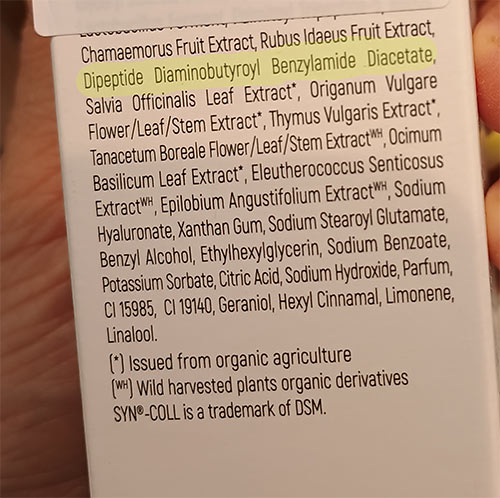
- Syn-Ake (Dipeptide Diaminobutyroyl Benzylamide Diacetate)
You’ll usually find them in products that mention “expression lines”, “smile lines”, “frown lines” or “crow’s feet” on the front of the packaging, especially eye serums and targeted wrinkle treatments.
Enzyme-inhibiting peptides (a shield for your collagen)
Enzyme-inhibiting peptides are like a light shield for your collagen. They help slow down the enzymes in the skin that break down collagen and other support structures, especially after UV exposure or general wear and tear.
You’ll often find them in products aimed at photoageing (sun-related ageing), uneven texture or “environmental stress”. They’re popular in creams and serums that talk about pollution, UV damage or “urban defence” on the packaging.
On ingredient lists, these peptides often take their name from where they come from. You might see:
- Soybean peptides
- Rice peptides
- Silk peptides
- Or more general terms like “phytopeptides” (plant-derived peptides)
If a product is marketed as protecting the skin from daily environmental damage or helping sun-stressed skin look smoother over time, there’s a good chance it uses at least one enzyme-inhibiting peptide in the mix.
Peptide cheat sheet: which peptides to look for based on your skin concern
Not sure which peptide you should actually be using? Use this as a quick match-up between your main skin concern and the names to look for on the label.
| Skin concern / goal | Peptides to look for on the label | Why they’re a good fit |
|---|---|---|
| Fine lines & early wrinkles | Palmitoyl pentapeptide-4 (Matrixyl®), Palmitoyl tripeptide-5, Acetyl hexapeptide-8 (Argireline), Pea peptides (Pisum sativum peptide) | Help support collagen, gently soften expression lines and make skin look a bit smoother and plumper over time. |
| Deeper wrinkles, sagging, mature skin | Palmitoyl tripeptide-5, Trifluoroacetyl tripeptide-2 (Progeline™), Hexapeptide-12, Biomimetic peptides, Maca peptides (Hydrolyzed Lepidium meyenii root) | Focus more on firmness, elasticity and loss of tone. Often used in “firming” or “lifting” formulas for mature skin. |
| Dry or dehydrated skin | Rice peptides (Oryza sativa peptide), Soy peptides, Palmitoyl tetrapeptide-7, Maca peptides | Help the skin hold onto water, support the barrier and improve comfort and smoothness when your skin feels tight or flaky. |
| Fine lines + dry / mature skin together | Palmitoyl pentapeptide-4 (Matrixyl®), Rice peptides, Soy peptides, Maca peptides, Copper tripeptide-1 (GHK–Cu) | Combine collagen support with hydration and repair. Great if your skin is drier, more mature and just looks “tired”. |
| Sensitive, redness-prone or reactive skin | Palmitoyl tetrapeptide-7, Acetyl tetrapeptide-15, Rice peptides, Soy peptides | Chosen for calming, barrier support and reducing visible redness. Work well alongside ceramides, centella and other soothing ingredients. |
| Oily or breakout-prone skin | Copper tripeptide-1 (GHK–Cu), Rice peptides, Pea peptides, other plant / phyto peptides (soy, rice) | Best in light, non-greasy formulas. These peptides can help calm inflammation, support repair and keep the skin environment more balanced. They support acne-prone skin but don’t replace acne treatment. |
| Uneven tone, dullness & dark spots (brightening) | Tetrapeptide-30, Soy peptides, Rice peptides, Biomimetic brightening peptides | Some peptides help with uneven pigmentation and UV-related discolouration. Plant peptides add antioxidant support and a gentle brightening effect. |
| Sun damage / “photoaged” skin | Soy peptides, Rice peptides, Silk peptides, Copper tripeptide-1 (GHK–Cu), Hexapeptide-12 | Helpful if you’ve had a lot of sun exposure. These peptides are often used to support collagen, improve texture and help skin recover from UV-related stress. |
| Post-treatment or stressed skin (after peels, retinoids, etc.) | Copper tripeptide-1 (GHK–Cu), Manganese tripeptide-1, Palmitoyl tetrapeptide-7, Rice peptides | Often used in “recovery” and “repair” products. Support skin repair, calm inflammation and help the barrier bounce back after stronger treatments. |
A few quick notes about plant, pea and biomimetic peptides
To keep things simple, here’s how to think about some of the names you’ll see pop up across different concerns:
Pea peptides (Pisum sativum peptide) – usually used for firmness, elasticity and general “revitalising” claims. You’ll often see them in anti-ageing and hydrating formulas.
Plant / phyto peptides (soy, rice, oat, pea, maca) – these come from broken-down plant proteins. They’re typically there for a mix of antioxidant, barrier-supporting, hydrating and sometimes gentle brightening effects.
Biomimetic peptides – this just means the peptide is designed to mimic a natural signal in your skin. It’s not a separate official category; biomimetic peptides can sit in any of the four main types, but in skincare you’ll usually see them linked to firmness and anti-ageing.
How to read peptide names without going mad
When you’re looking at an ingredient list, here are a few shortcuts that actually help in real life.
If you see “palmitoyl…”
For example: palmitoyl pentapeptide-4, palmitoyl tripeptide-5.
- What it means: it’s usually a signal peptide with a fatty “tail” added to help it sit better in the skin.
- Why it helps: these are the classic anti-ageing peptides used for firmness and wrinkles.
- What to do: if your goal is anti-ageing / firmer skin, seeing “palmitoyl + peptide” is a good sign.
If you see “tetra- / penta- / hexa-” in the name
For example: tetrapeptide-30, palmitoyl pentapeptide-4, acetyl hexapeptide-8.
- What it means: “tetra / penta / hexa” just tells you the size of the peptide chain (4, 5 or 6 amino acids).
- Why it helps: it doesn’t tell you which one is “better” – it just confirms you’re looking at a peptide.
- What to do: don’t stress about the number. Focus more on what the product claims (firming, brightening, soothing) and match that with your skin concern.
If you see Latin plant names like Pisum sativum, Oryza sativa, Glycine soja
- Pisum sativum peptide = pea peptide
- Oryza sativa peptide = rice peptide
- Glycine soja peptide = soy peptide
- Why it helps: these are plant / phyto peptides. They’re usually there for antioxidant, barrier and hydrating support, sometimes gentle brightening.
What to do:
- Good pick if you like plant-based formulas or want extra antioxidant / barrier support.
- Useful to know if you’re avoiding soy or have specific sensitivities.
If you see copper or another mineral in brackets
For example: copper tripeptide-1 (GHK–Cu), manganese tripeptide-1.
- What it means: this is a carrier peptide delivering that mineral to the skin.
- Why it helps: these are the “repair” and “recovery” style peptides – often used for healing, post-treatment skin or more advanced anti-ageing.
- What to do: reach for these if your main focus is repair, post-treatment recovery or you want something a bit more “active” in your evening routine.
If you see “biomimetic peptide” on the box
- What it means: it just means the peptide is designed to mimic a natural signal in your skin.
- Why it helps: it tells you the brand is positioning it as a more “intelligent” or advanced anti-ageing ingredient – but it’s not a special fifth category.
- What to do: treat it like any other peptide product: check your concern (wrinkles, firmness, etc.), look for the actual peptide names in the list, and don’t assume it’s magic just because it says “biomimetic”.
If it says “peptide complex” or “amino-peptide complex”
- What it means: this usually means a blend of several peptides, often signal peptides for anti-ageing. “Amino-peptide” is more of a marketing phrase (all peptides are made from amino acids).
- Why it helps: you know you’re getting more than one peptide, but not always which ones or in what amounts.
- What to do: use the front claims and your skin concern as your guide. If it says “peptide complex” but the peptides are the very last ingredients on the list, it’s probably a tiny amount.
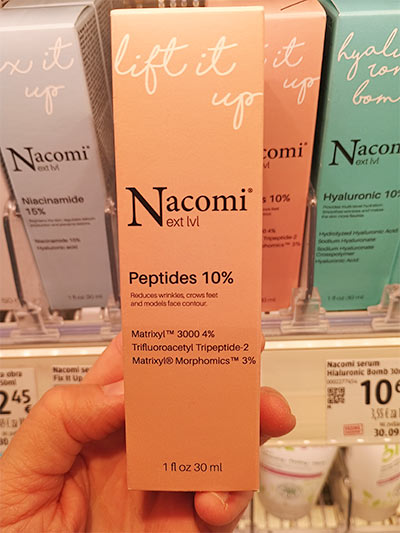
Are peptides right for your skin (and when are they not worth it)?
Peptides sound impressive, but they’re not always the first thing your skin needs. Whether they’re “worth it” depends on your skin goals, the rest of your routine and your budget.
Think of them as supportive team players, not the whole strategy.
Start with the basics before you add “extra” peptide products
Before you spend money on another peptide serum or cream, ask yourself:
- Do you wear broad-spectrum SPF most days?
- Do you have a moisturiser your skin actually likes (your moisturiser can absolutely contain peptides)?
If the answer is no, fix that first. A daily sunscreen and a moisturiser that properly hydrates and protects your barrier (with or without peptides) will always give you more visible results than adding a fancy extra product on top of a weak routine.
Peptides make more sense as a next step once the basics are in place and actually working for you.
If your main concern is fine lines and early ageing
Peptides can be a nice, gentle option if you’re starting to notice fine lines and early wrinkles, especially around the eyes and mouth.
- They work well if you don’t want to jump straight into strong retinoids.
- They also pair nicely with retinoids if you’re already using one – for example, a peptide moisturiser on top to keep things comfortable.
Peptides here are worth it if you’re looking for subtle, long-term smoothing and firmness, not overnight transformation.
If your skin is dry, tight or dehydrated
This is where peptide creams and serums can really shine.
Look for:
- A peptide moisturiser that also contains things like glycerin, hyaluronic acid and ceramides.
- A texture that feels rich enough, but not greasy.
If your face often feels tight after cleansing, or makeup clings to dry patches, a well-formulated peptide cream is usually a good investment, especially if you want your skin to feel more comfortable and look smoother over time.
If you’re oily or breakout-prone
Peptides themselves don’t clog pores, but the base of the product might.
If you’re oily or acne-prone and still want peptides:
- Choose light, water-based serums or gels.
- Avoid heavy, waxy creams that sit on top of the skin.
- Remember: peptides can support repair and calmness, but they won’t replace proper acne treatments.
If your budget is tight and your main issue is breakouts, it’s usually smarter to prioritise ingredients like salicylic acid, benzoyl peroxide, azelaic acid or whatever your dermatologist recommends, and treat peptides as a “nice extra” later.
If you have sensitive or easily irritated skin
This is where peptides often make the most sense.
- They’re usually well-tolerated and much gentler than strong acids or high-strength retinoids.
- They pair beautifully with calming routines that include ceramides, centella, panthenol and non-foaming cleansers.
If your skin reacts to almost everything, a simple routine with a peptide serum or moisturiser, a soothing cleanser and a good SPF can be a very good place to start.
If you’re mainly targeting dark spots and pigmentation
Peptides can help a little (especially certain brightening tetrapeptides and plant peptides), but they’re not the main stars here.
For stubborn dark spots, more targeted ingredients usually work harder, such as:
- Vitamin C
- Retinoids
- Azelaic acid
- Niacinamide
- Sunscreen (non-negotiable)
Peptides here are more of a support act: they can help with overall texture and skin health, but they shouldn’t be your only strategy for pigmentation.
When peptides may not be worth it
Peptides might not be the best use of your money if:
- You don’t use SPF most days and your moisturiser still isn’t doing its job (your skin feels tight, irritated or constantly dry).
- Your budget is tight and you need to choose between a peptide product and a great sunscreen or retinoid – in that case, go for the sunscreen or retinoid first.
- You expect fast, dramatic results in a few days – peptides are slow and steady, not a quick fix.
- You have a medical skin condition (moderate–severe acne, rosacea, eczema, psoriasis) that isn’t being treated. In that case, a dermatologist and the right prescription or over-the-counter treatment will do far more than any peptide cream.
If you already have a solid routine and a clear goal (for example, “my skin is dry with fine lines and I want it to look smoother and more comfortable”), then choosing one peptide-focused product – maybe a serum or a moisturiser you’ll happily use every day – can absolutely be worth it. You don’t need a whole shelf of them.
How to Use Peptides in Your Routine (And What Not to Mix Them With)
Peptides are pretty easy-going compared to many actives, but you’ll still get better results if you place them in the right spot in your routine and don’t throw them in with everything all at once.
Where peptides go in your routine
A simple order that works for most people:
- Cleanser
- (Optional) Toner / mist
- Peptide serum
- Moisturiser (this can also contain peptides)
- SPF in the morning
A few quick pointers:
- Peptide serums go after cleansing (and toner, if you use one), before your moisturiser.
- Peptide moisturisers go after any serums.
- You can use peptides morning and night. Many people like them in the evening because they fit nicely with “recovery” and repair.
You don’t need a peptide in every single step. One well-formulated product is enough.
What can you combine with peptides?
The nice thing about peptides is that they play well with most “boring but brilliant” skincare ingredients. They work especially well alongside hydrating ingredients (like hyaluronic acid and glycerin), barrier-supporting ingredients (like ceramides and fatty acids), niacinamide, gentle retinoids and antioxidants.
In most cases, you can layer a peptide serum under a hydrating serum and then use a simple moisturiser on top with no problems at all.
What not to mix (or when to separate things)
You don’t have to memorise a scary “do not mix” list, but there are a few combinations where it’s safer or more comfortable to separate things.
Strong, low-pH vitamin C serums
- These are the classic L-ascorbic acid serums (often 10–20%) that feel a bit tingly and watery.
- They can be quite acidic and sometimes destabilise more delicate formulas or just make the whole routine too harsh.
Easy solution:
Use vitamin C in the morning after cleansing, then layer moisturiser + SPF.
Use peptides in the evening, when your skin is focused on repair.
Strong exfoliating acids (high-strength AHAs/BHAs)
- Things like 10%+ glycolic acid toners, peel pads, AHA/BHA masks, etc.
- The issue isn’t that they “cancel out” peptides – it’s that you’re more likely to irritate your skin if you pile lots of actives on top.
Easy solution:
On heavy acid nights, keep the rest of your routine very simple: cleanser → acid → bland moisturiser.
Use peptides on your “off” nights when you’re not exfoliating.
Strong benzoyl peroxide treatments
- Often used in acne gels and spot treatments.
- Can be quite drying and irritating, especially around the same areas where you might want peptides.
Easy solution:
If you’re using benzoyl peroxide on specific areas, keep everything else there very gentle. You can still use peptides, but it’s often more comfortable to apply them on different steps or at a different time (e.g. benzoyl peroxide at night, peptide moisturiser in the morning).
Peptide FAQs
When should I start using peptides?
Most people can start using peptides in their mid to late 20s if they’re already consistent with daily SPF and a basic routine. They become more useful in your 30s and beyond, when fine lines, dullness and early loss of firmness are more noticeable. You don’t really need them as a teenager or if you haven’t nailed sunscreen and a good moisturiser yet.
Do peptides really work, or is it just marketing?
Some peptides are backed by good research, especially for supporting collagen, elasticity, repair and barrier function over time. The marketing can be over the top, but the ingredient class itself isn’t fake; the issue is that some products use very low amounts just to put “peptides” on the label. Look for clear claims that match your concern and real peptide names in the ingredient list, not just vague “peptide complex” wording.
How long do peptides take to work?
Peptides work gradually, not overnight. You may notice softer, better-hydrated skin within a couple of weeks, but changes in firmness and fine lines usually take at least six to twelve weeks of consistent use. If you like fast, dramatic results, peptides will feel more like a slow, steady background support.
What does “biomimetic peptide” actually mean?
“Biomimetic” just means the peptide is designed to mimic a natural signal in your skin. It isn’t a special fifth peptide category; biomimetic peptides can still be signal, carrier, neurotransmitter-inhibiting or enzyme-inhibiting. In practice, brands mostly use the term around anti-ageing and firming products to suggest a more “intelligent” or targeted effect.
What does “amino peptide” or “amino-peptide complex” mean?
This is mainly marketing language. All peptides are made from amino acids, so “amino-peptide” doesn’t tell you anything new; it usually just means a blend of different anti-ageing peptides in one formula. To know what you’re really getting, ignore the phrase and look for the actual peptide names in the ingredients.
What does “Peptide SYN™” on a product mean?
“Peptide SYN™” is usually a marketing way of saying the product contains one of the trademarked SYN® peptides, such as SYN-COLL or SYN-AKE. It’s a brand name, not a special type of peptide. To know what it really does, you still need to check the ingredient list for the actual peptide name (for example palmitoyl tripeptide-5 or dipeptide diaminobutyroyl benzylamide diacetate) and match that with your skin concern.
Are copper peptides worth it?
Copper peptides are one of the better-studied cosmetic peptides and can be worth it if you’re mainly interested in repair, smoother texture and gentle anti-ageing. They’re especially useful in “recovery” or regenerating products if you use retinoids, acids or have skin that’s a bit fragile and needs extra support.
They’re not essential for everyone, though. If your budget is limited and you don’t yet have a good sunscreen and moisturiser in place, those will make a much bigger difference than adding a copper peptide serum on top.
Do dermatologists recommend peptides?
Many dermatologists see peptides as a helpful “support” ingredient rather than a must-have. They’re often recommended for people who want anti-ageing benefits but can’t tolerate strong retinoids, or for those working on barrier repair and overall skin quality. Most experts still place sunscreen, moisturiser and proven actives like retinoids and vitamin C higher on the priority list, with peptides as a useful addition rather than the star of the show.
The bottom line on peptides
In the end, peptides are a nice extra – not a replacement for SPF and a good moisturiser. If you pick one peptide product that matches your main concern and actually use it consistently, you’ll get far more from it than chasing every new “miracle” formula.

- Dermaplaning Aftercare Made Simple: What to Do Next (and What to Avoid) - December 26, 2025
- Peptides for Skin: Benefits, Types & How to Use Them - November 20, 2025
- The Truth About Azelaic Acid for Dark Underarms – What Works and What Doesn’t - October 23, 2025


